


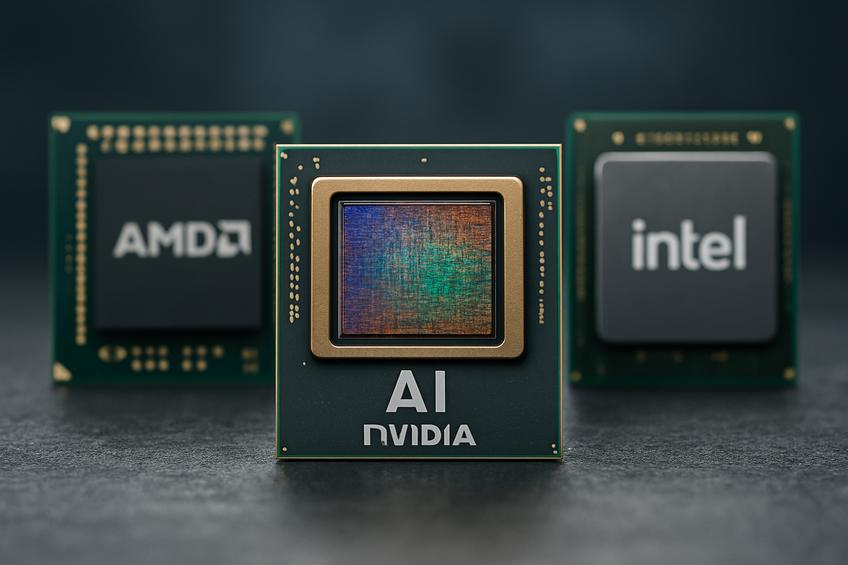
AI Chip Market Overview
The AI chip market is experiencing rapid growth, driven by increasing demand across various sectors such as cloud services, healthcare, automotive, retail, and entertainment. In 2024, the market size is estimated to reach approximately USD 123.16 billion and is projected to more than double to USD 311.58 billion by 2029, with a compound annual growth rate (CAGR) of 20.4%. This expansion reflects the critical role AI chips play in accelerating machine learning, deep learning, and data processing tasks that power modern artificial intelligence applications. Learn more about the AI chip market.
NVIDIA's Dominance in the AI Hardware Market
NVIDIA has solidified its dominance in the AI hardware market through continuous technological innovation, delivering unmatched performance and fostering influential industry partnerships. The company leads with a commanding market share of approximately 65% in AI chips, surpassing industry benchmarks and establishing itself as the go-to provider for advanced AI computing solutions. NVIDIA’s GPUs are designed with state-of-the-art architectures optimized for AI workloads, enabling accelerated processing of complex neural networks and large-scale data analytics.
Key performance metrics highlight NVIDIA’s growth trajectory, including a projected 20% year-over-year revenue increase, significantly outpacing the industry average. Their technological breakthroughs, such as the introduction of the NVIDIA Hopper and Ampere architectures, bring enhanced computational power and energy efficiency critical for both training and inference phases in AI applications.
Complementing its hardware excellence, NVIDIA has forged strategic alliances with major technology leaders and AI research pioneers, notably collaborations with Intel and OpenAI. These partnerships not only expand NVIDIA’s ecosystem but also catalyze innovation by integrating cutting-edge AI software with their hardware platforms. Explore NVIDIA's growth and market share.
AMD's Positioning Against NVIDIA
AMD has been making significant strides to position itself as a formidable competitor to NVIDIA in the graphics processing unit (GPU) market. Recent developments highlight AMD’s focus on technological innovation and strategic collaborations to challenge NVIDIA's dominance.
One key area of advancement is AMD’s continued development of its Radeon GPU lineup, which incorporates cutting-edge architectures designed to enhance performance, power efficiency, and ray-tracing capabilities. AMD’s recent GPUs, such as those based on the RDNA and RDNA 2 architectures, offer strong competition in gaming, professional graphics, and artificial intelligence workloads.
Additionally, AMD has expanded its ecosystem through partnerships with major hardware manufacturers and cloud service providers, enabling broader adoption of its processors in data centers and AI applications. For instance, AMD's integration of its EPYC processors alongside Radeon GPUs in HPC and AI infrastructures underscores its strategy to provide comprehensive computing solutions spanning CPUs and GPUs.
Collaboration within the industry also plays a critical role in AMD’s strategy. Joint initiatives with companies like Microsoft and other cloud leaders are aimed at optimizing software for AMD hardware. By advancing both hardware capabilities and strategic partnerships, AMD is successfully challenging NVIDIA’s market position. Explore AMD’s latest updates.
Intel's Strategic Moves
Intel is making a significant push to regain its foothold in the competitive AI chip market with the upcoming launch of its new data center AI processor, Crescent Island, scheduled for 2026. This move is part of Intel's broader strategy to strengthen its position in the rapidly expanding AI hardware space, competing against market leaders like Nvidia and AMD.
Crescent Island is optimized specifically for AI inference workloads and emphasizes energy efficiency, aiming to deliver superior performance per dollar and reduce operating costs. Intel plans to maintain yearly releases of new AI data center chips to keep pace with its competitors' innovation cycles. This effort underlines Intel’s commitment to delivering more AI processing power while keeping token economics in mind, ensuring high AI output at lower costs.
By focusing on AI-centric performance improvements and energy-efficient designs, Intel aims to re-establish its relevance in the AI chip sector. Crescent Island marks an important step in Intel’s strategy to regain market share and technological leadership in AI processors. Learn more about Crescent Island.
Future Directions in AI Chip Technology
The future of AI chip technology is set to be shaped by several emerging innovations and evolving market demands that will intensify competition among leading technology companies. Key directions include the development of highly specialized AI accelerators designed for diverse use cases ranging from data centers and cloud environments to edge computing and personal devices.
One notable advancement showcased at Hot Chips 2024 is the integration of fully optical compute interconnect (OCI) chiplets, which enable ultra-fast AI data processing with increased efficiency and reduced latency. This technology promises to enhance AI performance significantly, especially for large-scale generative AI workloads.
Additionally, open community-based software and industry-standard networking technologies, such as Ethernet, are gaining prominence to ensure scalability and flexibility in AI system architectures. Innovations like Intel's Gaudi 3 AI accelerator are examples of this trend.
Going forward, AI chips will increasingly address sustainability and energy efficiency, balancing powerful compute capabilities with lower carbon footprints. Understanding these trends will be crucial for organizations looking to leverage cutting-edge AI technology. Learn more about supporting AI initiatives.
Sources
- Barreras IT - Top IT Hardware Innovations of 2025 for SMBs
- Yahoo Finance - Intel Plans to Launch Crescent Island AI Chip
- Intel Newsroom - Hot Chips 2024 AI Architectural Expertise
- Sparkco AI - Investing in NVIDIA AI Semiconductors: An Enterprise Blueprint
- AMD - Official Newsroom
- MarketsandMarkets - Artificial Intelligence Chipset Market Report