


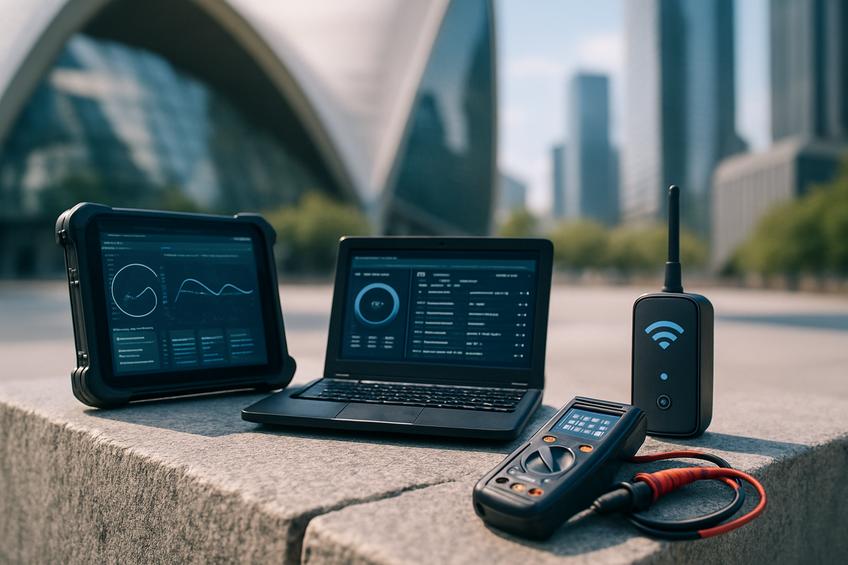
Portable Diagnostic Tools Revolutionizing IT Support
Portable diagnostic tools have become essential in the IT field, revolutionizing how technical professionals approach troubleshooting and system maintenance. These tools, ranging from handheld network analyzers to compact hardware testers, enable rapid identification and resolution of issues directly onsite without the need for bulky equipment or extended downtime. Their significance lies in improving efficiency, reducing service turnaround, and enhancing accuracy in problem detection [source].
Over the years, developments have focused on integrating advanced features such as wireless connectivity, real-time data analytics, and AI-powered diagnostics that predict potential failures before they occur. By 2025, we anticipate further advancements with even more sophisticated portable tools combining edge computing capabilities and seamless cloud integration, allowing for instant sharing of diagnostic data with remote experts, automated reporting, and smarter root cause analysis [source]. This evolution is expected to transform IT support by enabling proactive and highly efficient troubleshooting processes, minimizing disruptions for businesses.
Moreover, these innovations align with emerging trends in managed IT services, where continuous monitoring and rapid response are critical. Businesses adopting such tools gain a competitive edge by ensuring higher system reliability and faster incident resolution.
Key Features of Modern Portable Diagnostic Devices
Modern IT technicians rely on portable diagnostic devices equipped with several critical functionalities to efficiently troubleshoot and resolve issues on the go. Key features include:
- Connectivity Options: These devices must support versatile connectivity such as USB, USB-C, Ethernet, Wi-Fi, and Bluetooth to interface with various hardware and network environments.
- Intuitive User Interfaces: A straightforward, easy-to-navigate interface enhances productivity by allowing technicians to quickly access tools and interpret diagnostic results.
- Comprehensive Diagnostic Capabilities: Advanced diagnostic devices consolidate multiple testing environments into a single portable tool, covering various operating systems.
For instance, multipurpose USB diagnostic devices enable technicians to carry a compact testing suite that runs directly on the device without installation [source]. Furthermore, integrating remote diagnostics and cloud-based reporting empowers IT professionals to monitor system health and access test results anytime.
Learn more about effective IT support solutions in our guide on proactive IT maintenance.
Leading Portable Diagnostic Devices in 2025
As the demand for efficient and versatile IT tools grows, several portable diagnostic devices are set to lead the market in 2025:
- Handheld Network Analyzers: Ideal for network diagnostics, these devices support a wide range of protocols and offer real-time traffic analysis.
- Portable Wireless Spectrum Analyzers: Essential for diagnosing wireless issues by identifying interference and signal strength.
- Mobile Device Diagnostic Kits: Designed for testing a range of mobile devices, enhancing efficiency but limited in broader IT diagnostics.
- Portable Server Diagnostic Tools: Provide quick diagnostics for hardware faults and network connectivity [source].
Across these devices, key considerations include battery life, ease of integration with existing IT infrastructure, and the level of technical skill required to operate them effectively. Selecting the right tool depends heavily on the specific diagnostic needs and the context in which the device will be used.
For comprehensive IT support solutions that enhance diagnostic efficiency, learn more about our managed IT services.
Evaluating Technical Tools: Price, Performance, and User Feedback
When evaluating devices for technical use, three primary factors come into play: price, performance, and user feedback. Price remains crucial, balancing budget constraints with the need for reliable tools.
Devices that offer the best value typically combine competitive pricing with robust performance features, which include efficiency, durability, and compatibility with existing systems. User feedback provides real-world insights into reliability and ease of use [source].
Technicians should prioritize devices that fit within their budget while demonstrating consistent positive user experiences. In summary, a careful comparative evaluation that weighs price against performance metrics and user feedback is essential for selecting the most appropriate technical device.
Learn more about choosing the right tools in our Barreras IT Corp. Hosting service page.
Future Trends in IT Diagnostic Devices Beyond 2025
Looking beyond 2025, the development of IT diagnostic devices is expected to be significantly influenced by the integration of artificial intelligence (AI) and cloud-based solutions. AI-enhanced cloud services will enable more intelligent automation in IT diagnostics, predicting issues, optimizing performance, and enhancing security [source].
The rise of edge computing, combined with AI, will allow diagnostic devices to process data locally with low latency, improving real-time monitoring capabilities across various industries. Moreover, remote IT troubleshooting will evolve into a more predictive process, enabling IT teams to resolve issues proactively [source].
Sources
- Barrera's IT - The Importance Of Proactive IT Maintenance In Preventing Failures
- Barrera's IT - Remote IT Troubleshooting Best Practices For 2025
- Barreras IT Corp. Hosting
- Barrera's IT - Managed IT Services
- Ispectra Technologies - The Future of AI and Cloud Computing Trends for 2025 and Beyond
- NCH Stats - Breakthroughs in Medical Test Equipment
- Wecantrack - Comparison Site Statistics
- Medical Search - Top 5 New Medical Devices Changing Patient Care in 2025
- PCD Service Center - Service Center Overview